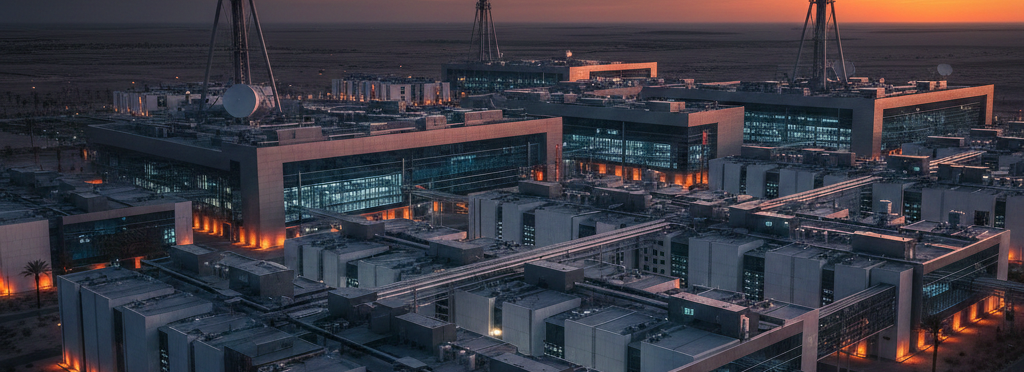
While Europe and North America scramble to build gas-fired plants to keep AI infrastructure online, Qatar is sitting on the world's most competitive energy advantage for hyperscale delivery.
Why it matters now
By mid-2026, Qatar will begin exporting LNG from its North Field expansion — increasing production by 85% to 126 million tonnes annually. Production costs? Under $3 per MMBtu. For context, US competitors pay $3-$5, and global averages sit higher still.
At the same time, data centres are deploying gas turbines faster than at any point since the 2002 US shale boom. In 2025-2026 alone, nearly every new hyperscale facility is being powered by natural gas — not renewables, not nuclear. Gas.
Qatar's gas infrastructure isn't a nice-to-have for hyperscale. It's the competitive moat that Europe and North America can't replicate.
The data centre energy crisis no one's talking about
Hyperscale operators face a brutal reality: AI workloads require 24/7, high-reliability power. Grids can't deliver it. Renewables can't match the load profile. Nuclear is years away.
So they're building their own gas plants.
- Texas — 80.6 GW of gas-fired capacity in development, driven by data centres
- Pennsylvania — Marketing itself as a data centre hub based on Marcellus shale gas access
- US Southeast — Utilities planning gas plant buildouts specifically for hyperscale demand
In 2025, global data centre electricity demand hit 800-1,000 TWh. By 2030, it could double. And 56% of that power still comes from fossil fuels — mostly natural gas.
Here's the uncomfortable truth: every hyperscale operator talking about "100% renewable energy" is deploying gas turbines today while planning nuclear for 2030. The bridge fuel isn't a bridge. It's the foundation.
Why Qatar's gas changes everything
Qatar isn't just expanding LNG production. It's creating a structural energy cost advantage that no other hyperscale market can match.
Production cost leadership:
- Qatar: $0.30-$3.00 per MMBtu (associated liquids pay for most LNG construction)
- US/Australia: $3-$5 per MMBtu
- Global average: Higher still
Operational advantages:
- 160 million tonnes of annual LNG capacity (including Golden Pass in Texas)
- 128 LNG carriers on order to support trading operations
- Strategic location between Europe, Asia, and Africa — can redirect supply based on demand
Energy security for hyperscale:
- Abundant gas eliminates the grid capacity constraints strangling European and North American projects
- 4,000 MW of solar by 2030 provides hybrid power options
- Government backing through National Vision 2030 prioritises energy infrastructure
What this means for hyperscale operators
If you're Google, Meta, or Amazon planning a hyperscale campus, energy cost is 20%+ of total cost of ownership. Qatar offers something no other market can:
- Lowest energy input costs globally — Gas at near-zero marginal cost
- No grid constraints — Build as much as you need, when you need it
- Scalability without penalties — Unlike Europe, where wholesale electricity prices spiked 267% near data centre hubs, Qatar's energy infrastructure scales without pricing shocks
In the US, data centres are driving residential power bills up by $17+/month in markets like Baltimore. In Qatar, energy abundance is a competitive weapon.
The delivery risk everyone's ignoring
Here's where it gets dangerous: Qatar's LNG expansion projects are massive energy megaprojects. North Field East alone is 88 bcm/y of new capacity — six industrial LNG trains coming online sequentially between 2026-2027.
These are the same delivery challenges that plagued offshore platforms and LNG terminals:
- Multi-EPC coordination — Civil, mechanical, electrical contractors working in parallel
- Commissioning complexity — Integrated systems testing across liquefaction, storage, and export facilities
- Supply chain vulnerabilities — Critical equipment with 18+ month lead times
In oil and gas, we learned that coordination failures kill projects more than technical complexity. Qatar's hyperscale ambitions face the same risk.
The country proved it can deliver (FIFA World Cup infrastructure was a $300B stress test). But energy megaprojects and data centre delivery require different expertise — and most local contractors have never done both.
PMO Hive's role
We bring energy megaproject discipline to hyperscale infrastructure:
- Schedule risk quantification — Monte Carlo analysis that predicts commissioning delays before they cascade
- EPC oversight — Independent governance that holds contractors accountable without adversarial relationships
- Interface management — Coordinating power, cooling, and IT systems across multiple EPCs and vendors
The Hive Platform
Our frameworks were built for North Sea platforms, LNG terminals, and offshore refineries — the exact projects that taught the industry how to manage complex, multi-billion-euro programmes without hemorrhaging cost and schedule.
From offshore platforms to data halls, from oilfields to fibre fields: governance and rigour win the future.